In this article:
Updated 2026
When you receive the news that you’ll be moving overseas with a military PCS, you’ll have plenty of questions, like:
What should we pack? Where will we live? Can we bring our appliances? How will we get our pet there? What about our vehicle?
These are all valid and common questions! Many of the details of an overseas PCS move (OCONUS) are similar to a move within the continental U.S. (CONUS), but there are also important differences to prepare for.
So, what should military families do before an overseas PCS? Starting the moving process as early as possible can reduce some of the stress. The first priority is connecting with your local transportation office (TO). They’ll provide counseling and checklists—including information regarding passports, travel, customs, and medical clearance.
Military OneSource's Plan My Move and the Defense Personal Property System (DPS) are helpful resources for organizing your overseas PCS, scheduling your household goods shipments, and tracking the details of your move. Your local Military and Family Support Center also provides relocation support, financial information, and details specific to your gaining installation.
Keep the following points in mind as you prepare for your OCONUS move.
Financial Planning for an Overseas PCS
An overseas PCS can come with additional expenses before reimbursements arrive. Understanding your travel entitlements and available financial assistance can help you budget more confidently.
Temporary Lodging Allowance (TLA)
Temporary Lodging Allowance (TLA) helps offset the cost of temporary lodging, meals, and other expenses while you're waiting to move into permanent housing overseas. Your finance office can explain your eligibility, authorized lodging period, and how TLA is calculated.
Dislocation Allowance (DLA)
Dislocation Allowance (DLA) is a flat amount that partially reimburses service members for expenses incurred when establishing a new household after a PCS. This is determined by pay grade and dependency status.
Advance Pay
If your budget won't cover the upfront costs of your move, you may be eligible for Advance Pay. This interest-free advance on future military pay can help cover relocation expenses, but keep in mind that repayments are automatically deducted from future paychecks. Factor those deductions into your budget.
Connect with the Military's Relocation Assistance Program
The Relocation Assistance Program provides valuable information and assistance during a PCS move. Military families are also eligible for one-on-one support.
From Military OneSource:
Relocation assistance service providers offer information, resources, referrals, and support for:
- Help with moving costs
- Household goods shipments
- Housing options
- Child care options, both on and off the installation
- Sponsorship and youth sponsorship
- Schools
- Spouse employment and license transfer
- Newcomer orientations and pre-departure briefings
- Loan closets
- Cultural adaptation
- Community resources
Find the Military Relocation Assistance Program through your installation’s Military and Family Support Center.

Photo by dimaberlinphotos via Canva.com
Command-Sponsored vs. Unaccompanied Tours
Command-sponsored dependents for an overseas move will be on military orders and have access to military installation resources and benefits.
Unaccompanied tours are shorter assignments for only the service member, often because of the location of the duty station, the length of the assignment, or unavailable family support resources.
Some families choose to move overseas without command sponsorship to certain locations anyway, but they won’t have access to military facilities or services. They may also need a visa to live in the host country and will need to pay their own moving costs for dependents.
Service members may not be eligible for COLA (Cost of Living Allowance) or OHA (Overseas Housing Allowance) for family members during unaccompanied tours. Still, some military families feel that the experience of living overseas or staying together is worth the added expense and planning involved.
See Can a Military Family Move Overseas Without Command Sponsorship?, for more information about why a military family would choose to move without command sponsorship, how to request command sponsorship, and the challenges that come with that decision.
Connect with Your Overseas Sponsor
The military member should be assigned a “sponsor” (not to be confused with the service member or command sponsorship) at the receiving installation who will provide invaluable help with specific questions regarding the area, including housing, youth programs, childcare options, schools, and even details like whether you should bring your large furniture or leave it in storage.
Sponsors usually have similar rank and family status to yours. The sponsorship program is available to all military families.
Military kids can have their own sponsor, too! Connect with the Youth Sponsorship Program to help ease your military child’s transition to a new school and community.
Gather Important Documents
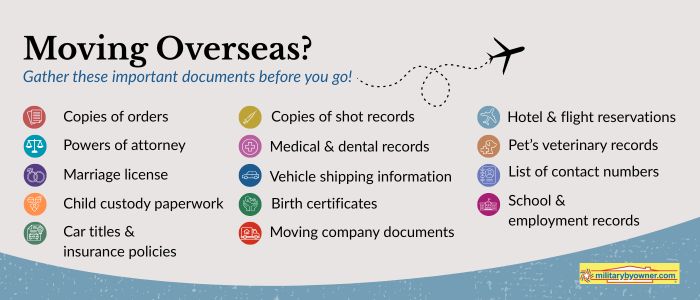
It’s a good idea to put paperwork/documents into a PCS binder or secure digital file. This will be your go-to resource throughout the move. Include all important documents and any other information you might need while traveling and settling into the new overseas location.
Documents to include in your PCS binder:
- Copies of orders
- Powers of attorney
- Vehicle shipping information
- Birth certificates
- Marriage license
- Child custody paperwork
- Car titles and insurance policies
- Moving company documents
- Hotel and flight reservations
- Your pet’s veterinary records
- Copies of shot records
- Copies of passports and visas
- School and employment records
- Medical and dental records
- List of contact numbers, in case your cell phone doesn’t work in the new area
See PCS Checklists for the months, weeks, and days leading up to and after your move.
Verify all paperwork is accurate. From 11 Things to Know Before Your First Overseas Move:
Double check to make sure that every family member is listed on official orders, and that names are spelled correctly. You’ll need that information in order to apply for the no-fee government passports required for PCS travel and all your other paperwork. Check with the specific location to see if you’ll also need a visa. Schedule your overseas medical clearance as soon as possible. Travel arrangements can't be finalized until your family receives medical clearance, and processing times can vary by location.
Prepare Your Household Goods Shipment
Time to purge and organize! First, confirm your household goods (HHG) weight allowance. Also consider whether your appliances—even small kitchen countertop appliances—will work in the new country (voltages may be different), which items are worth shipping, and which could be donated, sold, or put into storage. Your overseas sponsor can help you determine which items to bring.
You may choose to put some belongings in storage before the move. Overseas housing tends to run smaller, so now is a good time to streamline your belongings.
Here’s what military families need to know about long-term storage during an OCONUS PCS.
During an overseas move, all of your belongings will be packed into containers or crates and sealed. Moving companies are required to seal crates at your residence before leaving with your household goods shipment. At pickup, it's very important to verify all seals are intact and that the numbers match the inventory sheet before signing anything. Make a note of any seals broken or missing.
See your local TO and Containerization of Your Personal Property for more guidance.
Unaccompanied Baggage
Unaccompanied baggage, or express baggage shipments, are expedited, smaller shipments of household essentials and should arrive at your new duty station more quickly than the main HHG shipment.
Suggested items for your unaccompanied baggage shipment:
- Bedding
- Towels
- A few pots and pans
- Basic kitchen supplies
- Seasonal clothing
- Everyday essentials you'll need before your household goods arrive
Many overseas locations maintain "loan lockers" for families to borrow household basics, along with loaner furniture, so check with your sponsor for details. Keep in mind that your HHG will take weeks or even months to arrive, so be prepared for a wait or to even ship a few smaller things via mail right before you leave.
Professional Gear (“Pro Gear”)
Before packing day, ask your transportation office how to handle professional gear. These are work-related items the service member or spouse needs for official duties or employment, and they are handled separately.
Pro gear can include reference books, specialized tools, uniforms and duty-related clothing, communication equipment, or individually owned or issued gear required for the job. Service members are authorized to move up to 2,000 pounds of professional gear, and spouses can move up to 500 pounds of professional gear.
Pro gear must be identified before packing begins so it’s properly weighed, marked, and documented separately from the rest of your household goods.
Prepare for Overseas Travel
Make the most of your luggage allowance while flying! Military members and their families traveling on official orders are usually allowed several free checked bags per traveler and aren’t subject to the usual weight limits on baggage. Check with the airline, as policies vary.
It may be tempting to pack light, but remember your household goods won’t arrive immediately. Pack with the expectation that you’ll be living out of your suitcases for some time. You could also end up experiencing more than one season before your shipment arrives. Pack layers, extra shoes, prescription medications, swimwear, and a few comfort items to help your family settle in.
Important: Keep important documents in your carry-on.
Living in Temporary Lodging
You may spend extra time in temporary lodging or move into your home with loaner furniture before your household goods shipment arrives. It can be difficult to feel settled without your own things, but there are a few ways to make this in-between stage more manageable.
Maintain a routine. The military member will probably return to duty before everyone else feels settled. Keeping regular mealtimes, bedtimes, school routines, and daily habits can help the rest of the family feel more grounded.
Build in small treats. Life in temporary lodging can quickly feel repetitive. Add an unexpected treat when you can, whether it’s a family movie night, a favorite snack, a local outing, or a quick break from the hotel room.
Unpack what you need and stow the rest. Temporary lodging can get cluttered fast. Hang up clothes, use the dressers and shelf space, and then slide empty luggage or things you’re not using out of sight or even in the trunk of your car.
Stay active. When the newness wears off, make a point to leave your lodging space regularly. Fresh air, a walk around the installation, or a short trip into the local community can help everyone reset while you wait for your household goods and permanent housing.
OCONUS Housing Options
Depending on your location and eligibility, you may have the option to live in military housing, rent a home off-base, or, in some locations, buy a home off-base. There are pros and cons to each approach, and if you’re given the choice, take the time to weigh them before deciding.
Because housing availability varies widely by location, this is another good topic to discuss with your sponsor before you arrive. Ask about on-base housing wait lists, typical home sizes, commute times, parking, appliances, utilities, and whether families usually live on the installation or in the local community.
Regardless of where you live, you’ll be required to check in with the housing office before signing any lease. Renting a home in a foreign country is very different from renting in the U.S.
You’ll need to understand your Overseas Housing Allowance (OHA), how utilities are handled, local laws, rental lease terms, and more. Your housing office can help review lease terms, explain local rental customs, and make sure you understand what is and isn’t covered by OHA before you commit to a property.
If you’re considering buying a home overseas, research carefully before making that decision. Local real estate laws, financing, resale timelines, and tour length should all factor into whether buying makes sense for your family.
_(1).jpg)
PCS with Pets Overseas
Each country has different requirements when you PCS with pets overseas, so research breed restrictions, required quarantines, whether there’s a veterinarian on base or if you’ll need to go off base, airline regulations, and any customs requirements well before the move. One of the biggest causes of stress for military families moving overseas is how they’ll transport their pets.
For a smoother PCS with pets overseas, start early and keep your transportation office, veterinarian, and airline in the loop as soon as you know your destination.
See options for transporting your pets overseas.
Eligible service members may be reimbursed for certain pet transportation expenses during a PCS, including eligible OCONUS moves. Reimbursement is limited to one household pet (a cat or dog), and the amount and eligible expenses are governed by the Joint Travel Regulations. Because reimbursement policies and covered expenses can change, check with your transportation office or finance office before making travel arrangements.
Even if you qualify for reimbursement, you'll likely have out-of-pocket expenses for moving with pets. Begin budgeting for costs that may not be covered, such as:
- Health checks
- Vaccinations
- Possible quarantine fees
- Boarding fees
- Travel costs
- Import permits or other country-specific requirements
Every country has its own entry requirements, which can include micro-chipping, vaccinations, health certificates, import permits, or quarantine periods. Start planning as soon as you receive your orders. Pet travel requires appointments and paperwork that must be completed within specific timeframes before departure. In some cases, pets may need to travel separately if flights or required documentation can't be coordinated with your departure date.
The U.S. Department of Agriculture’s Animal and Plant Health Inspection Service provides specific information about what each country requires for animals to enter, including documentation and quarantine requirements.
Airline Policies for Travel with Pets
Because airline policies change frequently, check directly with the airline for current pet travel requirements, breed restrictions, kennel specifications, seasonal limitations, and military exceptions before booking your flight.
MilitaryByOwner’s extensive resource, Moving with Your Pets, provides helpful information to help with every stage of the move.
Shipping Vehicles and Driving Overseas
Driving overseas is a unique experience! If you own an oversized vehicle, you may want to rethink shipping it if you'll be living in a country with narrow roads, tight parking garages, or limited parking.
Not every overseas assignment includes eligibility to ship a privately owned vehicle (POV). Eligibility depends on your duty station and orders, so confirm your entitlement with your transportation office before making plans. If shipping a vehicle isn't authorized, you may need to purchase or lease a vehicle locally or rely on public transportation.
If you're authorized to ship a POV, your transportation office will provide instructions for scheduling shipment, completing required paperwork, and preparing your vehicle for transport.
Visit PCSmyPOV for more information.
Other Factors to Consider Before Driving OCONUS
Take into account the costs of maintenance, fuel, and whether parts and labor will be readily available for your vehicle. Depending on the country, you may be placed on fuel rationing.
Make certain that your U.S. driver's license won't expire before you leave the U.S., as you may be required to obtain a military or host-country driver's license after you arrive, and you’ll need a current license to do so.
Local licensing and vehicle registration laws vary from country to country, and deadlines tend to be tight. Check in with your gaining installation's Military and Family Support Center after you arrive to get the latest information and avoid any fines.
Important: Remember to contact your auto insurance company to update your policy and transfer your coverage overseas.
Helping Military Kids with the PCS Transition
Military children will have their own questions and concerns about moving overseas, and there are numerous resources designed to make their transition easier. The Youth Sponsorship Program offered at your installation is invaluable in helping your child feel welcome in their new community.
Researching and talking about the new location together can help children feel a sense of anticipation. Military spouse Courtney said her children were reluctant about a move to Germany, and she helped them look forward to the assignment by creating a “family travel bucket list.”
Invite each child to choose one destination or activity for the list. It could be a city, theme park, museum, favorite sports venue, or local landmark. For younger children, offer a short list of options. Once you’ve made the list, display it in your new home overseas and start checking off adventures when you can.
Additional ways to help children prepare for an overseas PCS move:
- Research the new location. Go online or head to the library together to learn about the new country, language, food, popular music, and local sports teams.
- Prepare for travel. Overseas flights are long, and your young ones may have never traveled by air for that length of time or even at all. Emotions from goodbyes may also be running high, so a little preparation can help. See Air Travel with Kids, for tips for traveling by plane with your kiddos.
- Make a wish list together of the places you’d like to visit. Mark a map with pushpins, create a travel journal, or use your phone to track the places you’d like to explore.
- Stay positive. Moving is difficult, and it’s important to allow time for grief and goodbyes. Still, make a point of looking forward to all the new experiences awaiting you.
OCONUS Education for Military Children
DoWEA and Local Schools
In most locations, you’ll have the option of choosing DoWEA schools, local schools (if available), or homeschooling. Some areas may also have private schooling availability.
Some military families opt to have their children attend off-base local schools to immerse them in the culture and help them learn the local language. This is location-specific as far as eligibility and availability, so check with the School Liaison Officer (SLO) at your location for information.
The Department of War Education Activity (DoWEA) provides education for dependents living at many overseas duty stations. School locations and enrollment change periodically, so visit the DoWEA website or speak with your School Liaison Officer for current information about schools serving your installation.
Military families living in locations without DoWEA schools may be eligible for tuition assistance for private schools, the option of dormitory schools, or distance learning. Check with your installation for specifics. Military members assigned to embassies or countries without DoWEA schools may have access to schools for embassy staff or State Department dependents.
Regardless of which option you choose, inform your child’s current school of your impending move and begin any transfer paperwork as soon as possible.
Homeschooling Overseas as a Military Family
If you’re planning to homeschool overseas, check with the SLO or installation school for more information, as many overseas locales have active and engaged homeschooling support groups.
Overseas homeschooled students are also eligible to participate in certain DoWEA school auxiliary services. These services vary by location but can include academic resources such as libraries, internet use, and textbooks; extracurricular activities such as band, sports, and club activities; enrollment in courses; Gifted and Special Education Services, and much more. Here’s an example of available services from the Europe SLO.
Exceptional Family Member Program (EFMP)
If you have a family member with special needs, the Exceptional Family Member Program (EFMP) can help ensure your family member's needs are met during and after your move, especially if your child is changing schools or you'll need specialized medical or educational services overseas.
Check out the EFMP & Me online tool for information and support anytime.
Military Spouse Employment Overseas
Finding employment is one of the biggest adjustments for military spouses during an OCONUS move. Military spouse employment opportunities overseas vary widely depending on your duty station, host country agreements, and the type of work you’re seeking.
Spouses find employment with the federal government, DoWEA schools, child development centers, military exchanges, or morale, welfare, and recreation (MWR) programs. Others continue working remotely for U.S.-based employers or operate home-based businesses, although employment and telework rules vary by country and are affected by Status of Forces Agreement (SOFA) provisions or host-nation laws.
Before your move, connect with the gaining installation's Employment Readiness Program or Military and Family Support Center. They can provide the most accurate, updated information about local hiring preferences, resume assistance, licensing requirements, and career resources. Military OneSource's SpouseWorks program (formerly SECO) also offers career coaching, overseas employment guidance, and job-search resources specifically for military spouses.
If you work in a licensed profession, check whether your credentials will transfer overseas or if additional requirements apply. Starting your research before you PCS can help reduce delays and make the transition into a new job easier.
Settling into Your OCONUS Duty Station
Making Connections
One of the best ways to settle into your new community is to take advantage of newcomer programs and connect with other military families. Check your installation’s website for current information. Most military bases maintain an active presence on social media, including spouses’ clubs and community groups, making it easy to build connections before you arrive.
Overseas military installations usually offer a newcomer's orientation and, in some cases, a tour of the installation and surrounding area. Take advantage of these programs, and then check in with your installation’s support services to learn about language courses, day trips, and events designed to help you get acclimated, learn about local customs and courtesies, and immerse yourself in all there is to know about your new country.

Photo by Nadezhda1906 from Getty Images via Canva.com
Explore and Enjoy Your Time Overseas!
Now that all the PCS planning and travel is behind you, take a breather and remind yourself of the unique opportunity you have in living in another country—something most people only dream about.
Although adjusting to a new country comes with challenges, it also brings opportunities to experience different cultures, explore new destinations, and create memories that last a lifetime.
Whether this is your first overseas assignment or you're returning for another tour, the experience can be one of the most rewarding chapters of military life. Embrace the opportunity, stay flexible, and enjoy everything your new duty station has to offer!
Overseas PCS FAQs
What should military families do before an overseas PCS?
Start by contacting your local transportation office, completing required medical screenings, gathering important documents, and connecting with your overseas sponsor. You’ll also want to research housing, household goods shipments, pet requirements, schools, and transportation options as early as possible.
What should I know before an OCONUS PCS?
An OCONUS PCS usually involves more planning than a stateside move. Military families may need passports, visas, medical clearance, country-specific pet documents, temporary lodging plans, and a longer timeline for household goods shipments.
How does an overseas PCS move work?
After receiving orders, you’ll work with your transportation office to schedule your household goods shipment, complete required screenings, arrange travel, and prepare for temporary lodging while you wait for permanent housing and your belongings to arrive.
Can military families live off-base overseas?
In many locations, military families may have the option to live in military housing or rent on the local economy. Your eligibility, housing availability, and Overseas Housing Allowance (OHA) will depend on your duty station and orders.
Can you bring pets on an overseas PCS?
Many families bring pets overseas, but every country has different requirements. Start early so you have time to research vaccinations, health certificates, microchips, airline policies, quarantine rules, and possible reimbursement for eligible pet transportation expenses.
Can military spouses work overseas?
Military spouse employment overseas varies by location, host-country agreements, SOFA rules, and the type of work. Before you move, contact your gaining installation’s Military & Family Support Center for current guidance on local jobs, remote work, licensing, and career resources.
MilitaryByOwner has helped military families navigate housing and relocation decisions since 2000. Explore additional PCS resources, military housing guides, and relocation tools designed specifically for military life.
back to top