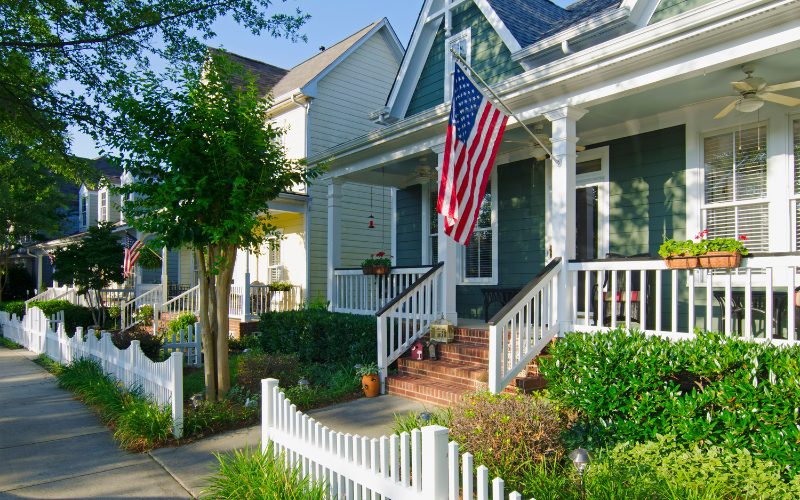
Photo by bauhaus1000 from Getty Images Signature via Canva.com
In this article:
Last updated 2026
There’s a variety of reasons that most military bases have wait lists for privatized base housing, but most PCSing military families cite affordability as the driving factor. Other reasons include the lack of off-base housing, the convenience of living near work, access to base amenities, and the camaraderie found while living near families similar to theirs.
Some military members won’t have a choice about where they’ll live because they’re assigned designated base housing for reasons related to rank, location, and type of job.
On the other hand, another military family won’t believe military housing is the way to go. They’ll mention that it’s limited in style and condition and that the assigned schools are questionable. In addition, the cost savings aren’t worth the downsides, such as paying mandatory BAH (Basic Allowance for Housing), even though the off-base rental market offers far better options.
The choice to live on base is easy for some families; for others, the cons far outweigh the pros. One thing is certain: there’s a lot to consider about living in military housing. If you’re trying to decide whether or not to live on base, this overview of base housing will help you find the right answer.
The History of Base Housing from the 1990s
After the need for modernized housing became dramatic and evident by the mid-1990s, Congress created the Military Housing Privatization Initiative (MHPI) in 1996 under the National Defense Authorization Act.
The MPHI was designed to attract private housing companies to build, renovate, and maintain quality homes for military families. The companies that ultimately signed on for this project agreed to 50-year lease agreements with the federal government.
As the years went on, the housing companies drastically improved housing throughout the military branches. The initiative appeared to be a cure-all, despite a few voices calling for more oversight from military leaders and even from the renters themselves.
By the late 2010s, however, media and federal investigations uncovered cases of neglect of maintenance and illness among military families living in base housing. The housing companies were accused of falsifying customer satisfaction surveys and ignoring repair requests.
Congress again intervened, demanding immediate action from base commanders and private housing providers to improve conditions, including the adoption of a tenants' bill of rights. The results have been mixed to date, but all parties involved are pledging to move forward with greater attention to the well-being of military families and their homes.
What Is Your "Why" for Living on Base?
One of the things military families should know before moving into base housing is their “why.” Practical factors such as budget, school access, safety, and community involvement typically drive decision-making, but other factors, such as pet restrictions in military housing and base amenities, also influence the final choice. Prioritizing a list of must-haves for a housing solution will guide you to the best answer.
Sometimes, deciding whether you should live on base or off base is decided for you. For example, if base housing isn’t available, the decision has been made for you—no need to consider the benefits or drawbacks of living on base. More often than not, however, the option exists, albeit most often with a waiting list, making the decision even more difficult.
Will Living on Base Save You Money?
Dig out the calculator and start crunching numbers. Simple math might make the choice to live on or off base obvious. Most housing companies take exactly the amount you’re allotted for BAH, which is a hard policy to accept if the service member earns a promotion but an upgraded home isn’t available.
The opportunity to save money exists when rental homes off base cost more than BAH, which is common in large cities near military bases. You can also save money on utilities if base housing accurately charges residents based on the average cost of similar properties. However, no system is perfect, and each housing company handles utility payments differently.
Here’s another perk to think about. Power outages from accidents or storms are a big deal on a military base, so they’re usually first in the area to restore power. It’s doubtful your house will be without power for too long, a much shorter period than living off base.
More Opportunities to Save Money While Living on Base
- Easy access to the Commissary, Exchange, and gas
- On-base childcare
- Low-cost and free entertainment
- Free basic yard maintenance
- Little interior and exterior upkeep
Does the Size and Condition of Military Housing Matter to You?
Living in military housing has benefits, but the quality and size of the available homes aren’t guaranteed. From base to base, options range from nearly condemned to brand new. The transfer to privatized housing improved overall livability, but not every duplex or tiny concrete-brick house on base was modernized. Add in the recent involvement of Congress to address the years of neglect by housing companies and base commanders, and there are even more factors to consider.
Your family’s size also determines whether living on base is viable. Large families with five or more children are eligible for homes with more bedrooms, but such options are not as readily available as three- and four-bedroom homes.
Each housing company creates policies for assigning homes, prioritizing the waitlist, and determining who’s eligible to live on base. They can also offer housing to non-DOW government workers, as well as retirees if housing remains vacant. Housing companies consider the base commander’s suggestions, but not always. It’s up to you to know what type of home you’re entitled to.
School Options on or Near Military Housing
A solid majority of military families choose public school education. However, on-base options vary drastically, meaning you’ll have to research school choices. Start the process early and check multiple sources, including first-hand accounts and one-on-one conversations with school administrators.
A few on-base schools remain under DODEA administration, but most have turned to their local school system for instruction, meaning your child may go off-base to school, or off-base kids may come on the installation to attend school. Each scenario has its pros and cons, and they are debatable within your family.
If you plan to homeschool, reach out to like-minded parents already living on base to ensure a strong homeschooling community is available to meet your needs. If a thriving homeschooling community isn’t prevalent, there may be options that military families endorse beyond the gates.
Private schools are an alternative if tuition and/or commute times aren’t a barrier. Many private schools offer military or sibling discounts and scholarships to help with the costs. Private school families have a tight network and are known for successful on-base carpools and for sharing collaborative tips to support families with day-to-day activities.
Your base’s School Liaison Officer (who likely works on base) is a solid reference for connections in student education, regardless of the public, private, or homeschool option.

Photo by davit85 from Getty Images via Canva.com
How Much Privacy Does Base Housing Offer?
Neighboring houses in military housing communities are often constructed close together, resulting in shared walls and yards. Understanding this lack of privacy is crucial for understanding what it’s really like to live in military housing.
For some people, privacy is the most important factor when looking for housing. In their perfect world, they’d prefer five acres of solitude. For others, connecting with neighbors is what makes living on base the best.
Be truthful about your feelings, but remember that on-base neighbors notice the contents of your recycling bin, your comings and goings, and the rest of your daily routine.
The active-duty person might have an extra vote in the privacy debate. Base living might not suit those preferring to avoid chance encounters with their superiors at the Exchange or food court. It’s totally reasonable to want to disconnect from work as much as possible when you go home.
Pet and Dog Breed Restrictions in Military Housing
Pets are part of the family, but aren’t necessarily welcome in base housing. Determining your pet's eligibility to live on base requires pre-planning. Although each housing company determines the exact policies for which animals are allowed (domestic versus exotic and acceptable dog breeds), military bases have input regarding animals in your home. Cross-referencing the two sources ensures clarity.
General pet restrictions found on most bases:
- No exotic pets, farm animals, or extreme reptiles are allowed
- Two to three total animals in a home
- Dog breeds typically banned: American Pit Bull, Stafford Bull Terrier, Bull Mastiff, Doberman Pinscher, Chow Chow, Wolf Breeds
Base housing guidelines were created partly to maintain animals' welfare. At your last home, a dog or cat who lived entirely outside might have been acceptable, but this isn’t true on base. Trust that your neighbors will contact authorities if you violate regulations.
Keep in mind pet security. Will you need a fence? Not every house has one installed, and your new address could be on a waitlist for fence installation.
back to top
More On-Base Living Tips
- Use all amenities: pools, JAG, car mechanic, medical clincs, social clubs, community meeting space, and playgrounds.
- Read the base (online or in print) newspaper to keep up with fun activities and important notices.
- Rejoice in a blank, beige house. There are many ways to decorate military housing while still getting your deposit back.
- Make nice enough with your neighbors so they’ll help pull in trash cans or pick up packages for you.
- Hold yard sales at least once a year. You’ll have a great turnout, especially if it's community-wide.
- Prepare off-base family and friends for entering the base. They’ll need you as an escort, IDs, updated car insurance, and vehicle registrations.
How Do You Apply to Live on Base?
Each private housing company has a specific application process for living on base. It’s best to start researching online with the base location and housing provider to understand their procedures. For example, Fort Meade NSA housing in Maryland is operated by Corvias, while Hunt Military Communities operates the housing at the Air Force Academy in Colorado.
Starting the application process as early as possible shortens the number of days sitting on the waitlist, but hard copies of military PCS orders aren’t always processed promptly. If you don’t have PCSing orders in hand, work with your incoming housing office to determine whether they have options, such as provisional waitlists or temporary lodging.
Military families should expect a standard application submission, either online or in person, with supporting documents required to ensure accurate eligibility according to family size and rank. You’ll likely need:
- Copy of PCS military orders
- Copy of most recent and updated DEERS Enrollment Form (DD1172-2)
- Branch-specific confirmation of clearing outgoing duty station (examples: DA31–Leave Form, AF Form 227)
- Copy of current LES
- Valid Special Power of Attorney if your spouse is absent
- Valid photo ID
- Other branch-specific forms, such as Sex Offender Disclosure and Acknowledgment (AF Form 4422)
Don’t ignore the housing company’s FAQ links. These will provide detailed information on waitlists, pet policies, upgrading a home after a promotion, adding family members to the lease, and more.
Deployment, Vacancy, and Death of a Service Member
Special considerations, such as vacancies during deployment and departures after a service member's death, are usually explained on the housing company’s website. Find relief in the knowledge that the Department of War directs special housing benefit provisions for dependents of service members who die while serving on active duty.
Can we stay in base housing if the military member deploys?
Yes, you can usually continue living in military housing while your spouse is deployed.
Private housing companies also know that it’s common for the family left behind after a deployment to relocate temporarily to seek help from family and friends. Most support the move and only require notification to your neighborhood office; some work with the military police to provide extra security measures.
As the tenant, however, you’re bound to the lease agreement and must pay monthly rent regardless of occupancy.
How long can we live in base housing if the military member dies?
From Military OneSource about living in military housing after a service member has died:
If you are living in government housing stateside as an eligible family member, you may qualify to continue to do so for up to a year after your service member’s death. If you want to remain in quarters past the 365th day, you must submit a written request to the installation commander via the appropriate housing office. If approved, rental charges at the current rate may be applied, as the Basic Allowance for Housing entitlement ends 365 days after the date of the member’s death. If you are in leased government housing, the 365-day rule and payment of BAH for any unused days still apply. If you are in government housing overseas, the rules may be different according to the status of forces agreement, or SOFA, for that country.
Base living can be an amazing experience if you’re prepared for the lifestyle. In addition to practical research, join local groups to learn the nitty-gritty details of everyday life. There are people who want to share their good and bad experiences with you!
Stay updated with military housing options with MilitaryByOwner, whether you’re living on or off base. We have contact information for privatized housing offices in addition to home listings surrounding most military bases across the country.
By Dawn M. Smith

back to top