Photo by Truecreatives from TrueCreatives via Canva.com
In this article:
Prospective homebuyers often encounter terms such as "split-level," "ranch rambler," and "mid-century modern," whether through real estate listings or popular house-hunting shows. While these phrases may be widely recognized, the styles they represent are not always easily identified in practice.
House hunters are likely to encounter a wide variety of homes on the market, making it helpful to understand which architectural styles they prefer and which they do not. Certain design elements may be immediately appealing, others less so, and many homes will feature a mix of both.
Equipping yourself with home design knowledge before attending Sunday open houses can help save time by eliminating properties that would be immediate deal-breakers. For instance, buyers who wish to avoid multiple sets of stairs may want to rule out split-level homes.
First, it’s helpful to know the general construction style of the house.
Common Types of Homes
Townhouse
Townhomes are typically constructed with multiple levels, often featuring kitchens located on an upper floor. Because they share walls with neighboring units, noise can sometimes be a concern. Ownership generally includes both the land on which the townhouse sits and the home’s exterior, making maintenance the responsibility of the owner. Even so, most townhomes are considered relatively low-maintenance.
Outside, each townhouse has a separate entry and typically a small yard or deck. If a garage is available, it may also share a wall in the interior space. Townhouses are part of a homeowners association that has fees to cover community lawn care, snow and trash removal, and other maintenance tasks.
Condominium
Condominiums often attract first-time buyers due to their affordability and low maintenance requirements. However, many buyers are unaware that condo ownership typically extends only to the interior living space. The land beneath the building is not individually owned; instead, all condominium owners share ownership of the exterior and common areas.
Condos are typically one to two levels. Sometimes there are elevators within a multiple-level building. Occasionally, they have shared hallways, entries, and interior walls. Parking options vary from community lots to heated underground garages and may incur additional fees.
Owners also pay homeowners association fees, and they tend to be higher than those for a townhouse. Fees include payments for exterior maintenance, insurance for repairs, and trash and snow removal.
Moving into a new home? Try these affordable home decor ideas for military families on the move.
Multi-Family Residences
Multi-family residences range from duplexes to four-plexes. They are, in simple terms, one house split into more than one dwelling unit. Multi-family homes are built in two ways: either side by side or with a few floors. Some have a common entry, while others have separate doors for each tenant.
The buyer owns the entire home, and the individual units cannot be sold separately. However, they can be individual rental units. Many military buyers purchase a multi-family property as an investment.
Detached Single-Family Home
Often, the most common and most expensive option is a single-family home. It can be a significant undertaking, starting with the price tag and down payment, and continuing with ongoing home decor changes, maintenance, and repairs. Despite the upkeep, the biggest benefit of the property is that it can be updated to the style and preference of the owner.
While a single-family home may be a long-term investment, the owner has the freedom to sell as needed. A house in a neighborhood may or may not have a homeowners association, but the fees are typically not as high as those for a townhouse or condominium.
All this house hunting might lead you to wonder, “What is my home decor style?” How to Decorate Your Home will help you decide for yourself.
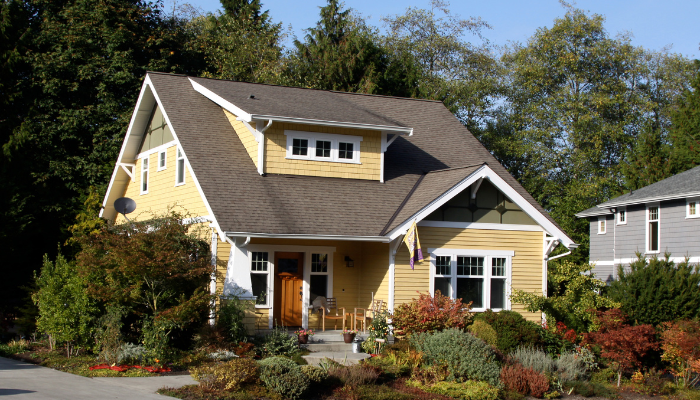
Photo by davelogan from Getty Images Signature via Canva.com
The Top 10 Architectural Styles Found in the U.S.
Although many of the previously listed home styles may share the "look" of a common architectural style, it’s common for buyers to envision a detached single-family home with a specific architectural design.
In the United States, these are the top 10 most preferred types of homes.
- Craftsman
- Country
- Traditional
- European
- Ranch
- Farmhouse
- Cottage
- Modern
- Southern
- Mediterranean
Since there are discrepancies among house style names from region to region and across the country, the best descriptions with illustrations of each residential style can be found at The National Association of Realtors publication, Realtor Mag.
Why Certain Home Styles Are Preferred
Personal experience often determines a buyer’s preference for specific characteristics. For example, if someone had an idyllic childhood in a country home, this might be the first style they choose. Conversely, a ranch home could be the perfect fit if someone hated the flights of stairs in a standard colonial.
Today, the influence of home shows on popular DIY projects largely impacts what viewers decide is the best type of home for their families. It’s easy to get swept into the final product or "reveal shot" that encompasses a fully decorated and repaired home of the owner’s dreams.
Exposure to various house styles is helpful for comparison and contrast, but the abundance of information can also lead to disappointment if certain features or affordable home decor options are not available within a buyer’s price range or location.
Geography and climate often play a crucial role in prevalent residential styles. This is why there aren’t usually traditional brick homes in the Southwest desert, and it’s also why not every location has a home with a basement due to flooding concerns.
Pre-determining personal needs and financial plans quickly rules out any type of residential style that doesn’t fit. For example, although the home buyer might have their heart set on a modern-rustic farmhouse, those home styles aren’t as prevalent in downtown Washington, DC, where it’s necessary to find an easy commute to and from work.
Buying a home is a complicated and thoughtful process. Hopefully, after deciding the practical parts of the new home, there will be room to explore different architectural styles to suit your personal preferences.
By Dawn M. Smith

back to top