
Photo by Jacob Lund via Canva.com
In this article:
One of the most frequently searched topics on MilitaryByOwner is the military clause, and for good reason. At best, the term “military clause” is confusing; at worst, it perpetuates inaccurate information from military service days long past.
To get a head start on deciphering why or why not you would need a military clause in your lease, you’ll first need to learn about the Servicemembers Civil Relief Act (SCRA). This knowledge will help you understand what the military clause can actually do for you.
Take a look at this short video, and then read on!
What is the Servicemembers Civil Relief Act (SCRA)?
The SCRA is a federal law. It was enacted in 2003 to legally protect service members (and their dependents) who must break their lease to continue serving. More specifically, the SCRA is designed to help alleviate the stress associated with civil obligations for all active-duty service members, reservists, and National Guard members while they’re on active duty.
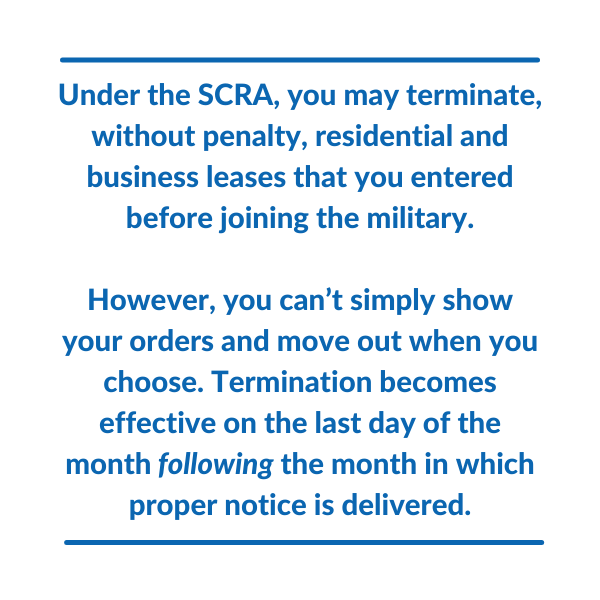
Under the SCRA, you may terminate, without penalty, residential and business leases that you entered before joining the military. It also provides for the termination of a lease entered into while in military service if you receive orders to deploy for a period of at least 90 days or orders for a permanent change of station (PCS).
The SCRA covers far more than early termination on your military rental property. The act is comprehensive and protects against penalties for outstanding credit card debt, mortgage payments, pending trials, taxes, and termination of lease.
However, to legally break your lease, you can’t simply show your orders and move out when you choose. Termination becomes effective on the last day of the month following the month in which proper notice is delivered.
For example, if the lease requires a yearly rental and you provide proper notice to your landlord on July 15th, your effective termination date would be August 31st. You would then need to pay rent through that date. Here’s the entire list of what is required by the SCRA to break your lease legally.
- A written notice of your intent to vacate due to military orders.
- A copy of your official military orders.
- Full payment of rent for the month in which you give notice.
- Full payment of rent for the following month.
For more details about how the SCRA compares to the military clause, take a look at these posts:
What if your landlord ignores your rights under the SCRA?
The Department of Justice (DOJ) advises military members to contact their nearest Armed Forces Legal Assistance Program office to verify that the SCRA applies to your situation. Dependents of service members can also contact or visit local military legal assistance offices where they reside.
If the legal assistance office cannot resolve the complaint, it may refer the complaint to the DOJ. The DOJ will then review the matter to determine whether more action is appropriate.
What is a military clause?
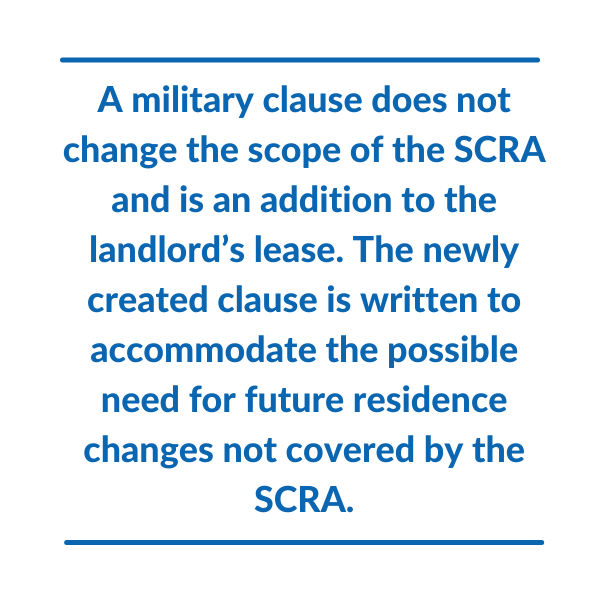
A military clause does not change the scope of the SCRA and is an addition to the landlord’s lease. The newly created clause is written to accommodate the possible need for future residence changes not covered by the SCRA, for example, your wish to live on base if a home becomes available. In this case, a PCS wasn’t ordered, so the local move on base is entirely your preference.
Another example of when a pre-approved military clause could be helpful includes a local move to an installation that isn’t far enough away to require PCS orders, a PCA move (Permanent Change of Assignment). A clause describing the distance threshold you prefer would prove useful to military families in traffic-congested areas, such as the National Capital Region.
For military families with orders to The Pentagon who later receive orders to another installation in the D.C. area, such as Marine Corps Base Quantico, the commute distance does not necessarily mandate PCS orders that would activate SCRA permission to terminate a lease. However, the daily commute will change drastically. Therefore, a military clause that permits a termination of lease in the event of reassignment to another installation would greatly alleviate the service member’s commute.
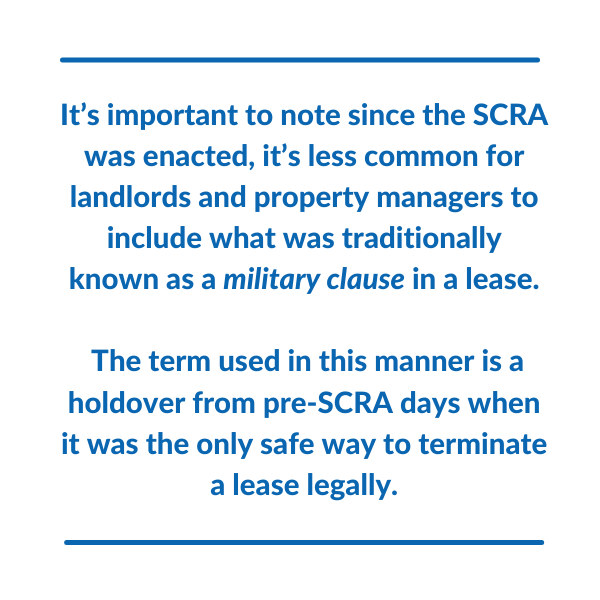
It’s important to note that since the SCRA was enacted, it’s less common for landlords and property managers to include what was traditionally known as a military clause in a lease. The term used in this manner is a holdover from pre-SCRA days when it was the only safe way to terminate a lease legally.
Should I have a military clause in my lease?
It depends on your family’s situation. Beyond the above examples of changing locations, a need for routine medical care for a child at a military treatment facility could also prompt a move. A series of deployments, TDYs, and training that takes the military member away for months at a time and severely disrupts the family’s ability to thrive could also require a family to move to another location.
Remember, your landlord must be fully aware and sign off on any military clause terms beyond the SCRA you try to insert in the lease. They may reject your terms and choose to work with another military renter.
A military clause spells out the terms that the tenant and landlord agree upon through clear communication before the lease is signed. Both the landlord and renter should consider having a local military legal office review the military clause, as state laws do play a part in how a military clause is executed in your state.
Individual state rental property and landlord laws typically supersede the military clause in a lease, which sometimes benefits the renter. Some military clauses state that if a military family is ordered into base housing (for example, a senior leader required to live in a particular housing billet), the landlord must terminate the lease.
In other states, however, the military family does not need orders to move into base housing; instead, they simply need to show that they’ve been moved off the housing waiting list and offered a home.
back to top
Why would a landlord feel conflicted about including a military clause?
Depending on the location and local rental market trends, or past personal experience, military landlords may hesitate to sign off on a military clause because it could present a potential financial problem. A rental property is a business, and maintaining consistent tenancy is the bedrock of a profitable rental business.
While military families benefit from an agreed-upon military clause when Uncle Sam presents a last-minute change of plans, a military clause sometimes becomes a challenge for the landlord; for example, if a service member used a military clause to terminate a lease for an ordered temporary assignment (TDY/TAD) that exceeded 90 days.
Suppose the termination of lease occurs outside of the traditional moving season for that community. In this case, the landlord will have difficulty finding a new tenant. They will likely have a longer vacancy period than planned if they only rent on traditional one-year leases during the moving season. This early departure can create a ripple effect of unexpected turnovers for future PCS cycles.
What is the reverse military clause?
If you're a military homeowner turned landlord, have you heard of a reverse military clause? Because you, too, work for a boss with fickle demands. You’ll want to know about this opportunity to inform the renters of your early return. Here’s an excerpt of our post, What Is a Reverse Military Clause?:
“A reverse military clause is simply a clause inserted into a rental lease by the homeowner stating they will return to their house if the military assigns them orders to come home. They can amend the details, including but not limited to, how much notice they give their renters and how the security deposit is returned.”
Before signing a rental agreement, use this information and military legal assistance if needed to accurately discuss both the SCRA and a military clause with your potential landlord. You’ll specifically want to remember these facts:
- A military clause is different from the SCRA.
- Under specific terms, the SCRA allows a lease to be broken without the need for a secondary military clause placed in the rental agreement.
- A military clause is only valid if your landlord signs off on the circumstances you detail or if the state law supersedes the language.
The bottom line is that, unless you know of an upcoming event, such as receiving an invitation to live on base, you likely don’t need a military clause in your lease. The SCRA should cover traditional PCS situations when you have to break a lease early.


back to top